


Could Our Area See a Revival of the Mosquito Fleet on the Waters of Puget Sound; Legislation Would Allow More Counties to Launch Ferries


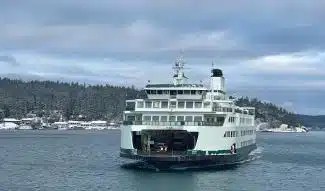
Kitsap Transit’s passenger-only ferries could have more company on Washington waters if the Legislature finds extra money in a tight budget year. (Photo by Tom Banse of the Washington State Standard)
There are only a handful of passenger- only ferry routes in Puget Sound today, but in the early 1900s the waters were swarming with small ferries.
An estimated 2,500 vessels that measured anywhere between 30 to 200 feet in length ferried early settlers across the water on about 25 different routes in the heyday of the “Mosquito Fleet,” according to the Kitsap History Museum. Smaller waterfront communities like Squamish, Indianola and Olalla were not isolated from urban Seattle and Tacoma, as boat owners offered passenger service, mail delivery and cargo freight hauling on large steam-powered sternwheelers and sidewheelers, and quicker, smaller boats.
ADVERTISEMENTS:
 Chris Miller – Windermere Real Estate Bainbridge


 But now, decaying docks and abandoned pilings are all that is left of the Mosquito Fleet after fallout from the Great Depression and two warring monopolies spelled the ferry network’s doom, all the while demand for auto carrying ferries grew. It was at the remnants of one such route – possibly the “Kitsap Line” that connected Seattle, Illahee, Brownsville and Manzanita Bay – that 23rd District Rep. Greg Nance (D–Bainbridge Island) had an “epiphany moment.”
Nance was swimming in Manzanita Bay off Bainbridge Island when he came across a stone that was inscribed, “Manzanita Landing,” recalled the sophomore lawmaker sitting in his new office at the Washington State Capitol. He’s on the fourth floor now with a view, graduating from his freshman- year digs. Kitsap-proud Nance has been a champion of ferries since his first days in Olympia.
He asked his father about the stone and soon found himself learning about the Mosquito Fleet and the cross-sound connection Kitsap County and its neighbors used to enjoy. His epiphany? It used to be much easier to get from just Bainbridge Island to Bremerton. Only a couple of decades later, Nance has introduced a House Bill that could see the Mosquito Fleet renewed while the Sound contends with a connectivity issue.
“By looking to our maritime history and heritage, we can actually build out a healthier, more connected future,” Nance said.
 Washington State Ferries https://wsdot.wa.gov hasn’t restored any routes to pre-COVID-19 pandemic levels during fiscal year 2024, the agency reported. Last year, WSF completed 97.6% of its scheduled sailings, of which 82% were on time.
WSF operated 15 vessels in its regularly scheduled service throughout fiscal year 2024 with a 16th as a third, unscheduled boat on the Fauntleroy-Vashon- Southworth route. Before the pandemic, WSF operated 19 vessels at peak service in the summer and 17 in the winter.
Nance’s HB 1923 would serve as a “Plan B,” while WSF chases restoration. The agency is planning to buy five new vessels, the first two of which are planned for arrival in 2028, but Nance said riders need relief sooner. And what if they get bad news that procurement will take longer or will cost more money than anticipated?
To redistribute some of the ridership’s dependance on WSF, the bill would revise state law to allow waterfront communities to again create their own fleets of passenger-only ferries with capacities of up to 149 people each.
 “We’ve reached a boiling point where we really need relief and we can’t be futzing around waiting,” Nance said. “We’re not trying to compete with WSF. This is a pressure relief valve that gives WSF the time it needs to really turn the tide and get new boats built, get our maintenance regime back up to speed, recruit the next generation. These things can happen in parallel.”
The Mosquito Fleet Act’s status in Olympia
In February supporters of Nance’s bill filed into a hearing room on the ground floor of Nance’s office building at the State Capitol. Kitsap figures like Bainbridge Island Mayor Ashley Matthews, Bremerton City Councilman Jeff Coughlin and Kitsap Community Resources Executive Director Tony Ives spoke before the House Transportation Committee for the Mosquito Fleet Act. Others, like Orcas Island resident Thomas Bridge appeared online.
For Bridge and his fellow islanders, a state-sanctioned Mosquito Fleet is a necessity – because he’s already operating one. Bridge helped create the unincorporated Community Water Taxi to supplement delayed or cancelled WSF service to the San Juan Islands after county councilman Justin Paulsen asked him to help ferry some kids home whose ride was cancelled, reported the Salish Current.
 Bridge told the room of legislators that he helped ferry about 1,000 passengers in the past year and a half in the San Juan Islands; whether it was to get married, bring blueberries to market or go to court, mass, a graduation, or community celebration.
House Bill 1923 would allow the San Juan county government to create a foot ferry itself. Current state law only allows a governing body on the western side of the Puget Sound with a population of more than 200,000 with existing WSF services to establish a passenger-only ferry – that’s essentially just King, because of Vashon Island, and Kitsap counties. But, Nance’s bill would extend that power to transit bodies from any local governing body on the water.
The San Juan Islands could be a potential new route among a few, Nance said, mentioning Orcas Island or Friday Harbor to Bellingham that could be led by San Juan County. The Port of South Whidbey and the Port of Everett have been working for the past couple of years to rebuild a passenger-only ferry dock for a Clinton to Everett route. Nance also mentioned routes from Suquamish to Ballard, Kitsap to Des Moines or Bellevue to the University of Washington.

Nance envisioned state dollars to stimulate the routes. A previous version of his bill came with a $50 million competitive grant program for start-up passenger- only foot ferry routes, but that provision was stripped during executive session for the House Transportation Committee wherein Democrats and Republicans convene separately to discuss their vote on certain bills, Nance said.
The original draft did not come with a fiscal note, but was The Washington State Department of Financial Management noted that the bill would cost $1 million even if there wasn’t a dime in the funding pool. A second version of the bill will put aside the grant opportunity to pare down the fiscal note, but Nance wants to revisit the idea of state funding later in session.
While the Washington State Transportation Department contends with a $1 billion budget deficit for the 2025-2027 biennium, Nance is pushing a large boulder up a steep hill asking for state dollars. Increasing construction costs and waning gas tax revenue have threatened transportation projects as lawmakers decide where to save a wayward billion dollars.
While the House Transportation Committee heard testimony for the Mosquito Fleet Act, Vice Chair Julia Reed (D–Seattle) repeatedly asked representatives from waterfront communities if their government bodies could provide enough funding to justify the state’s potential commitments to float new foot ferry routes.
 “Without a doubt, our ferry-served communities deserve better service,” Reed — who was married aboard a Vashon Island ferry sailing — asked Coughlin as he took the stand. “But… is the city of Bremerton or the county of Kitsap financially ready to shoulder the cost of running the significant expansion of fast ferries or will the state need to subsidize the service?”
The growing pains of fast ferry service
Kitsap Transit’s passenger-only fast ferry service models Nance’s cross sound vision. Riders line up behind yellow and black striped belts at the Bremerton Ferry Terminal. As they wait for the orange and turquoise-painted ferry to arrive, they can hear sea lions chortle on the water and watch jellyfish bob alongside the dock. After the ferry pulls in, bumping against the platform, riders from Seattle file out and into downtown Bremerton.
Ridership on Kitsap Transit’s https://www.kitsaptransit.com/ fast ferries hit record numbers in 2024, with a 12% increase from 2023, and is only expected to grow this year.
The transportation service is picking up slack after WSF dropped its two-boat service between Bremerton and Seattle to one boat during the pandemic. WSF isn’t anticipated to restore the route until at least 2028, so Kitsap Transit operates seven extra round trips with WSF funding on weekdays and another seven on Saturdays part of the year.
But Kitsap’s passenger-only ferry system had its fair share of growing pains before it matured to its current stature.
Kitsap Transit’s inaugural fast ferry sailing from Bremerton to Seattle was in 2017, decades after a previous foot ferry service from WSF was scrapped. Homeowners along Rich Passage claimed the wakes created by WSF’s ferries were damaging their beaches and bulkheads and voters delivered the final nail in coffin rejecting a referendum that would have cured a blow to WSF’s budget that briefly capped car tabs at $30.
It took three attempts at the ballot box to bring fast ferry service back to Kitsap. Voters rejected a sales tax increase to fund the service twice before they accepted Kitsap Transit’s third try, which added 3/10 of a 1 percent sales tax. That funding is supplemented by fares and revenue for operations and state and federal dollars with a local match for capital projects.
When the tax dollars began to flow, Kitsap Transit launched the fast ferry service with only one boat – the low wake catamaran Rich Passage 1, which as almost immediately ran into problems. A malfunctioning propulsion control box sidelined the ferry in its first week, then a failed turbocharger and blown head gasket cancelled sailings weeks after, before it suffered exhaust system issues a month later. Kitsap Transit spent $91,000 at the time fixing the vessel and its budget for repairs on all of its foot ferries and docks was just over $1 million.
A total of 118 sailings were cancelled in its first four months before service became more consistent, The Kitsap Sun reported that November. Last year, Kitsap Transit completed 99% of their scheduled sailings, 97% of which were on- time.
Nance believes the Mosquito Fleet Act would’ve been a slam dunk two years ago when the state wasn’t plagued with such a budget shortfall. “We need to show that glaring need to legislators and to community members and leaders so that when we’re prioritizing limited dollars, we realize that folks in the West Sound have been under invested for (more than) 25 years and the result of that, we don’t have reliable public transportation the way we need,” he said.
The bill is now in the House Rules Committee for further review.

If you’d like to read more articles from The Island Wanderer Blog website, click here, to subscribe to The Island Wanderer Blog, click here.
ADVERTISE WITH US! We offer exceptional rates and packages for advertisers, to learn more, contact us at Contact Us | THE ISLAND WANDERER
—


