


Travelogue: Looking For a Fun Trip Abroad? Try Portugal, a Wonderful Place to Bike, Tour and Soak in Lots of Culture, History and Food!

It’s that time of the year – dark, dreary and somewhat oppressive – when our thoughts start turning to warmer climes and exotic places.
Depending on your time constraints, frame of mind, budget and vacation style – fast and furious, or slow and easy – there are any number of great escapes right at our fingertips. We’re talking, of course, about domestic places like Arizona, New Mexico, Southern California or Hawaii.

If you want to expand your thinking, however, there are greats options abroad in Italy, France, Morocco, Greece, Egypt, Mexico and many other wonderful spots one can identify by spinning a globe (if you still have one of those), or searching the Internet.
ADVERTISEMENTS:
 Chris Miller – Windermere Real Estate Bainbridge


We’ve been fortunate enough in the recent past to escape to places like the Yucatan Peninsula on the Mexican Riviera, the Dolomite’s in Italy, or the Cliffs of Moore in Ireland. All beautiful locations to snorkel or sunbathe, ski some incredible terrain, or look in awe upon the roaring North Atlantic Sea.
While those places are truly magnificent in their own right, and each have left us with a lifetime of memories, we found ourselves looking for something a bit more historically significant and physically challenging.
That’s about the time a friend emailed us last summer and asked if we might be interested in joining a group organized by Vermont Bike Tours heading to Portugal in late September of 2025. At first blush, it sounded very tempting and we raised our hands to the affirmative.
But after a weekend of contemplating, my wife decided to back out due to a pending knee replacement surgery she successfully completed in October. Understandably, she just couldn’t see herself biking, hiking and walking with a sore knee in hilly Portugal.

True to her nature, though, she gave me the green light to move forward, and I was able to recruit another Bainbridge biking buddy to round out the group. Of the 18 people on our tour, there were eight people from Washington and six of us from Bainbridge Island, along with an assortment of friends of friends from Minneapolis and Colorado.
We won’t bore you with too many of the travel details other than to say the flights were relatively stress free, the accommodations were first rate, the restaurants and eating options were superb and the biking was fantastic, and just arduous enough in some locations, especially for a pedal pusher like me, that you felt a great sense of personal satisfaction when the day was done.
For the newly initiated, Portugal lies along the Atlantic coast of the Iberian Peninsula in southwestern Europe, and is surrounded to the north and to the east by Spain. It was once Europe’s greatest power, highlighted by the reign of Ferdinand and Isabella. The Old World country was a trading center for centuries as goods traveled in and out of Lisbon, its biggest port city. Today, it shares a lot of similarities – both geographically and culturally – with countries in Northern Europe and on the Mediterranean.
It’s cold, rocky northern coast and mountainous interior are sparsely settled, and are relatively scenic and wild, while the country’s southern tier – the Algarve – is warm and fertile. The latter, where we bikers spent several days, is an area where you’ll find Olive groves dotting rolling hills, along with avocado, limes, and pomegranate trees in abundance. The rugged Estrela Mountains (the Star Mountain Range in English) lie between the Tagus – that we sometimes followed on our biking journey – and the Mondego rivers, and contain the highest point in mainland Portugal.

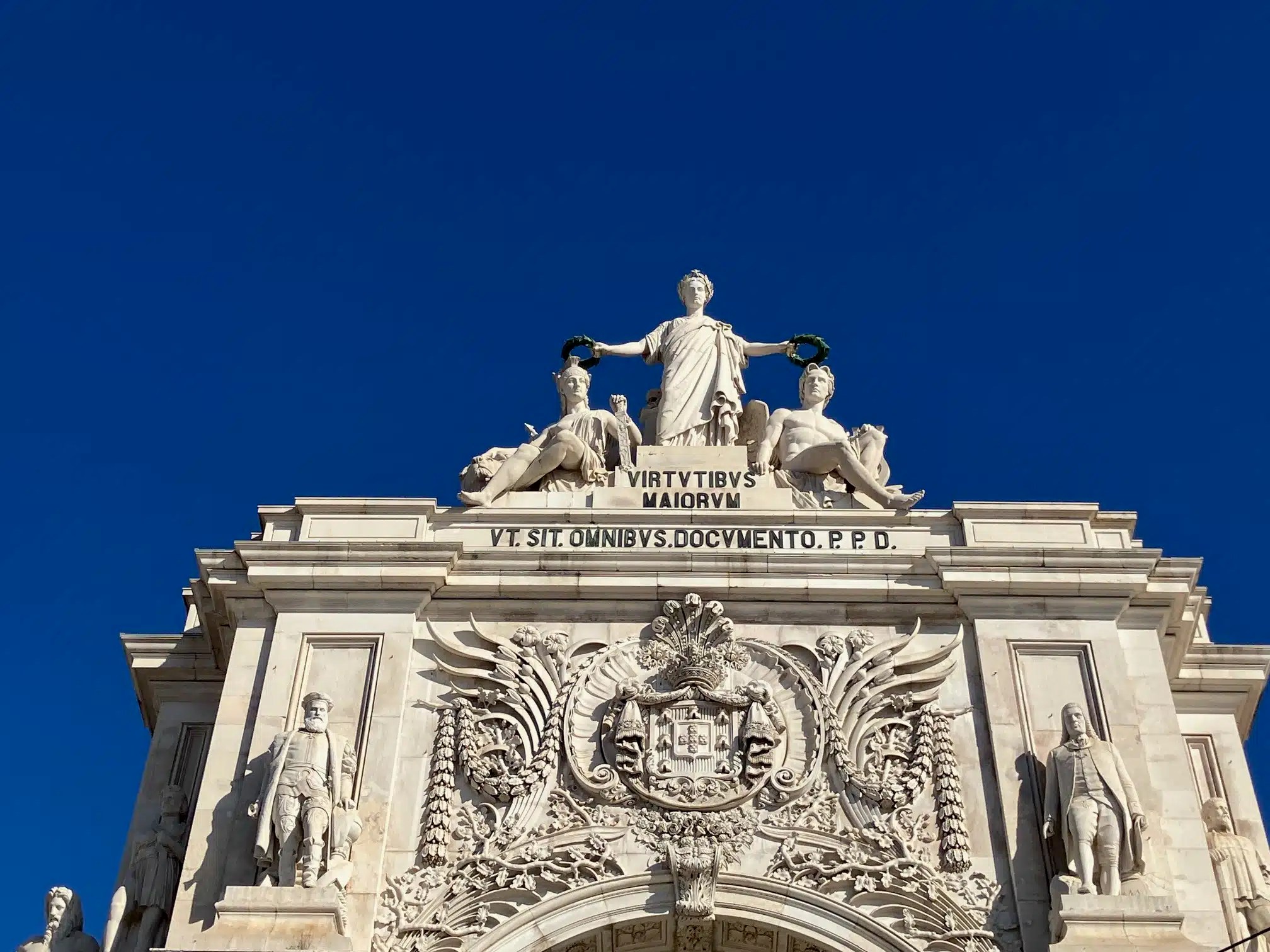
We arrived in Lisbon on the afternoon of the 24th of September after a nine hour flight from Seattle to Frankfurt, Germany, and another two and a half hour ride from Frankfurt to Portugal’s largest city. Once on the ground, we were whisked to our hotel in the old town of Lisbon by a VBT driver. The Pousada de Lisboa – our hotel for the next few days – was located literally feet away from the famous Lisboa Plaza and was within easy walking distance of the historic districts of Baixa, Bairro Alto and Alfama.
We had a few days on our own before the bike tour officially began and we made the most of it, touring some of the back streets of Lisbon, finding some out of the way restaurants with unusual cuisine, such as seafood dishes featuring crawdad, shrimp, and sole smothered in butter sauce, or stumbling onto a plaza in the Alfama with a Fado music concert in session with hundreds of spectators clapping along.
One day the lot of us took a guided walking tour and learned some of Lisbon’s enchanting history. Some of it includes a massive earthquake in the 17th century that caused a Tsunami and transformed the city’s architecture, a former King who received a Rhinoceros as a gift and let it roam the city’s streets. That situation eventually lead to the creation of Lisbon’s wonderful tiled byways, presumably put in place to hide the Rhino’s refuse. And, last but not least, the city and country’s long dictatorial reign by communist leaders that caused economic turmoil and suffering throughout much of the 20th century.


Other highlights in Lisbon featured a visit to the National Tile Museum, where there are multiple floors of centuries old tile works and art on display, as well as a Medieval Church that the museum literally surrounds and includes an impressive gold-plated altar and tabernacle as well as huge paintings of nobles, priests and saints, along with side altars and pews. On the other side of Lisbon, we stumbled upon Pastel de Belem, where tourist and locals alike stand in lines going out the door to sample a taste of its famous and delightful pastry called “Pastel de nata”. We found that the little morsel of fried dough – with a secret recipe going back hundreds of years – was best eaten with a dapple or two of cinnamon and powered sugar. Delicious.
Following a bus ride across the Vasco de Gama Bridge, the longest span in Western Europe, our biking journey started with a rainy and windy ride in a small village that included a mile or so of cobblestone streets. There’s nothing quite like riding an unfamiliar bike on the same sort of wet roads that have taken down many a Tour de France rider over the years. Thankfully we made it through the whitewashed town of Redondo, home, it turns out, to a 500-year-old pottery tradition, and on to some relaxing country roads in what is known as the Alentejo region. We rode over rolling hills and through forested areas until we eventually shimmed up a steep hill to Monsaraz, one of Portugal’s oldest settlements that is enclosed by an imposing castle.


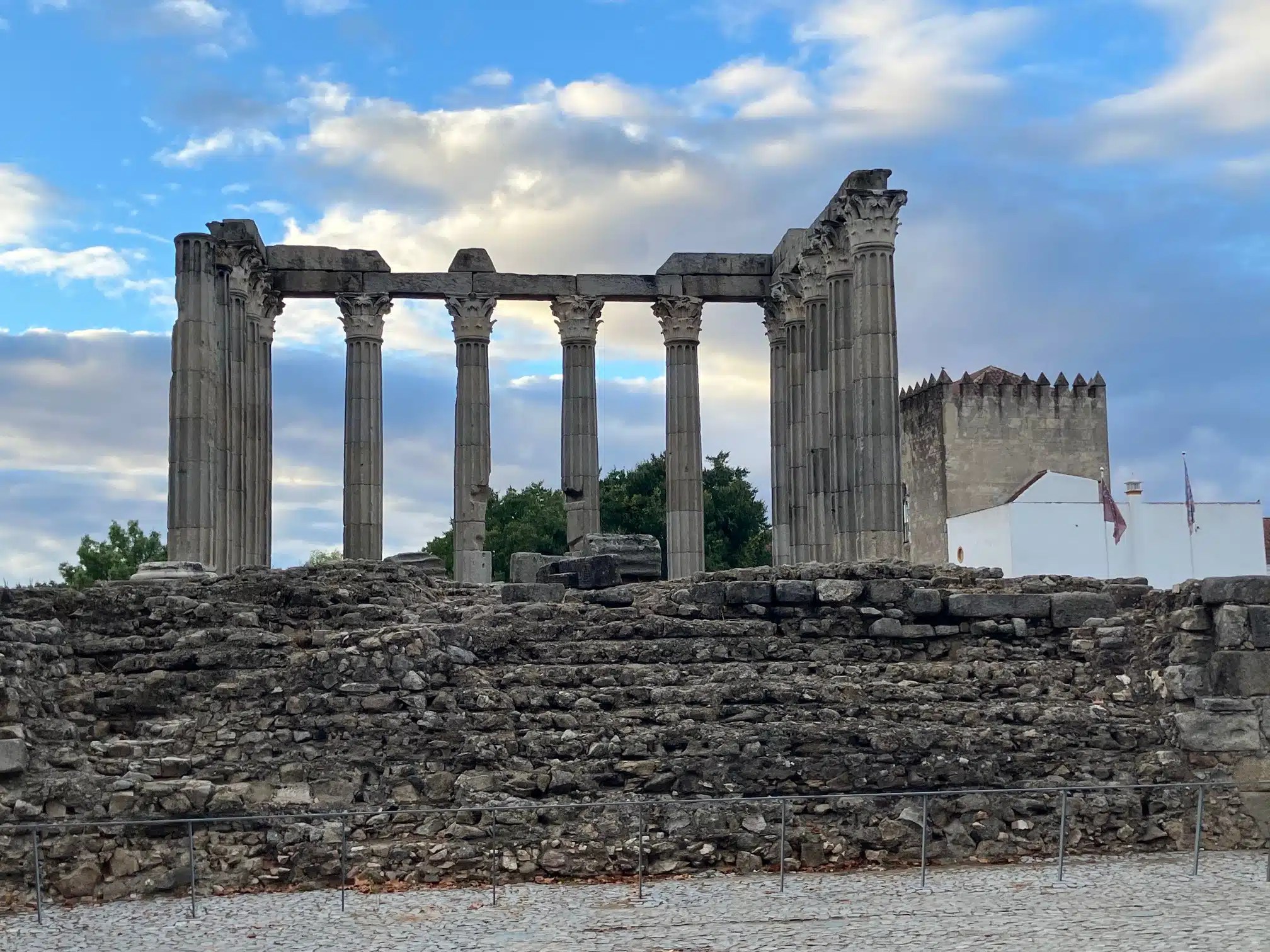
Monsaraz, which provides stunning views of the Alentejo, has been occupied by various civilizations down through the centuries from Romans, Visigoths and Arabs, to Mozarabs, Jews and Christians. Later that day, we ventured into the UNESCO World Heritage site of Evora and visited the famous Sao Francisco Church and the eerie Chapel of Bones, where human skeletons are enshrined into the walls and ceilings. The latter was built by 16th century Franciscan monks.
As we soon discovered, you can easily combine bike riding, walking and history into one day, and still have time for a nice glass of wine or two and an authentic Portuguese meal. We rode the next day on a relatively flat stretch of the Campo Branco or White Plains region of the Alentejo to the hillside town of Mertola, that sits high above the picturesque Guadiana River. We got to our hotel a bit early, so myself and another rider pedaled a 28-mile loop in a nearby valley. It was hot, exhilarating and bit challenging, as there were more hills than we expected, but fun nevertheless. Most others in our group opted for a more sensible activity, taking a walking tour of Mertola’s rich history that dates back all the way to the Phoenicians, Carthaginians and Romans. The town also contains the only medieval Mosque from the 500-year occupation of the Moors in Portugal.
Mertola, with it’s inexpensive Gelato, curvy streets and colorful buildings, was one of my personal favorites stops on the trip. Besides our group, there were few if any other tourists in town and it was easy to walk around in the warm evening air and take in the scenery, with the river below and the moon rising, and creating wonderful shadows on the ancient cobbled streets.

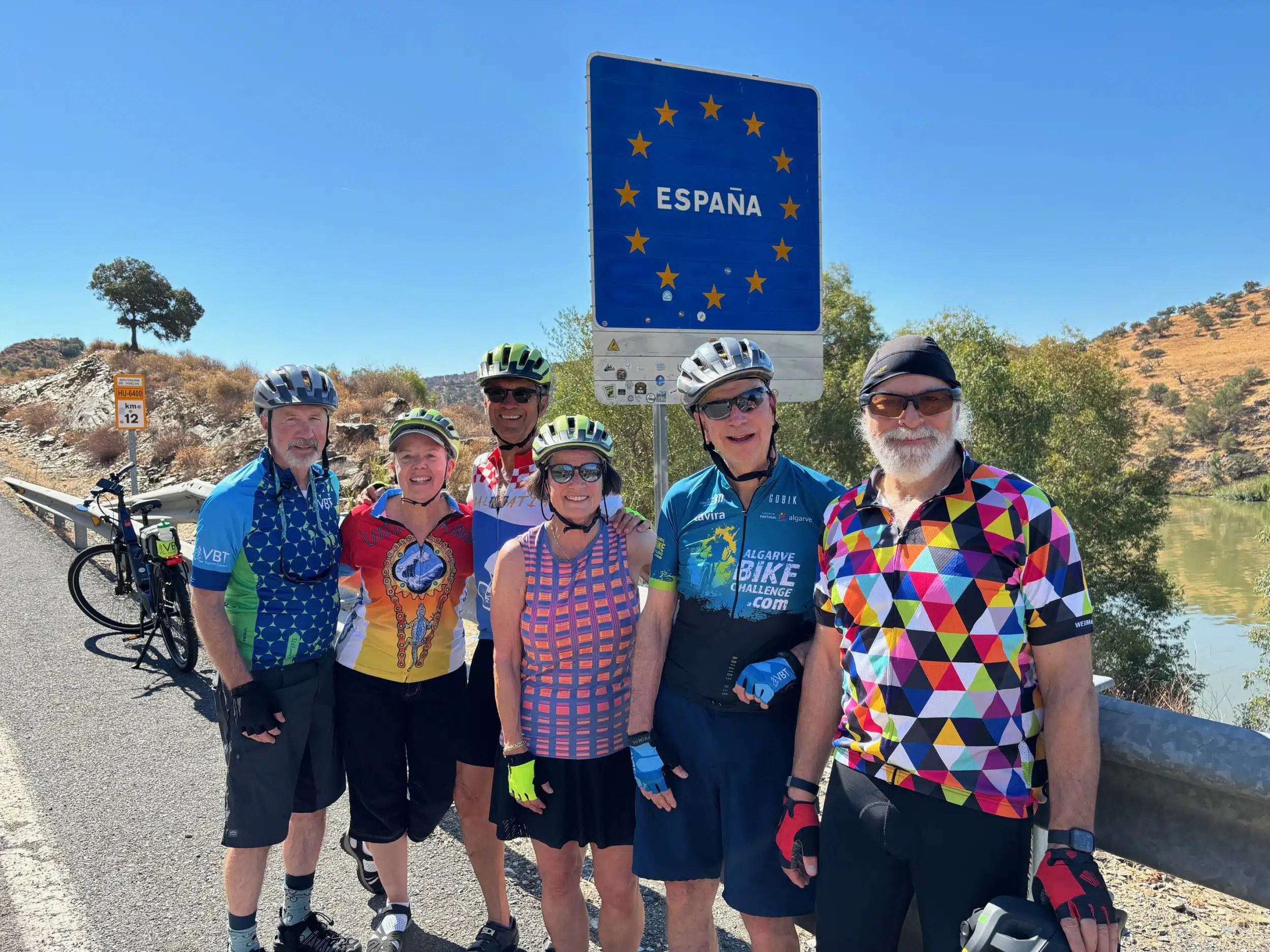
The next day we rode through the Guadiana Valley Natural Park – of of 30 natural areas in Portugal protected by the government – and wended our way down a steep decline on to a bridge that straddled the border between Portugal and Spain. Of course, we all had to get off our bikes and get pics of ourselves on the border crossing, with the Spanish flag behind. Nearby, we had lunch at a wonderful riverside cafe overlooking a Marina. Most of us opted for a river cruise back up the river to our hotel in Mertola.
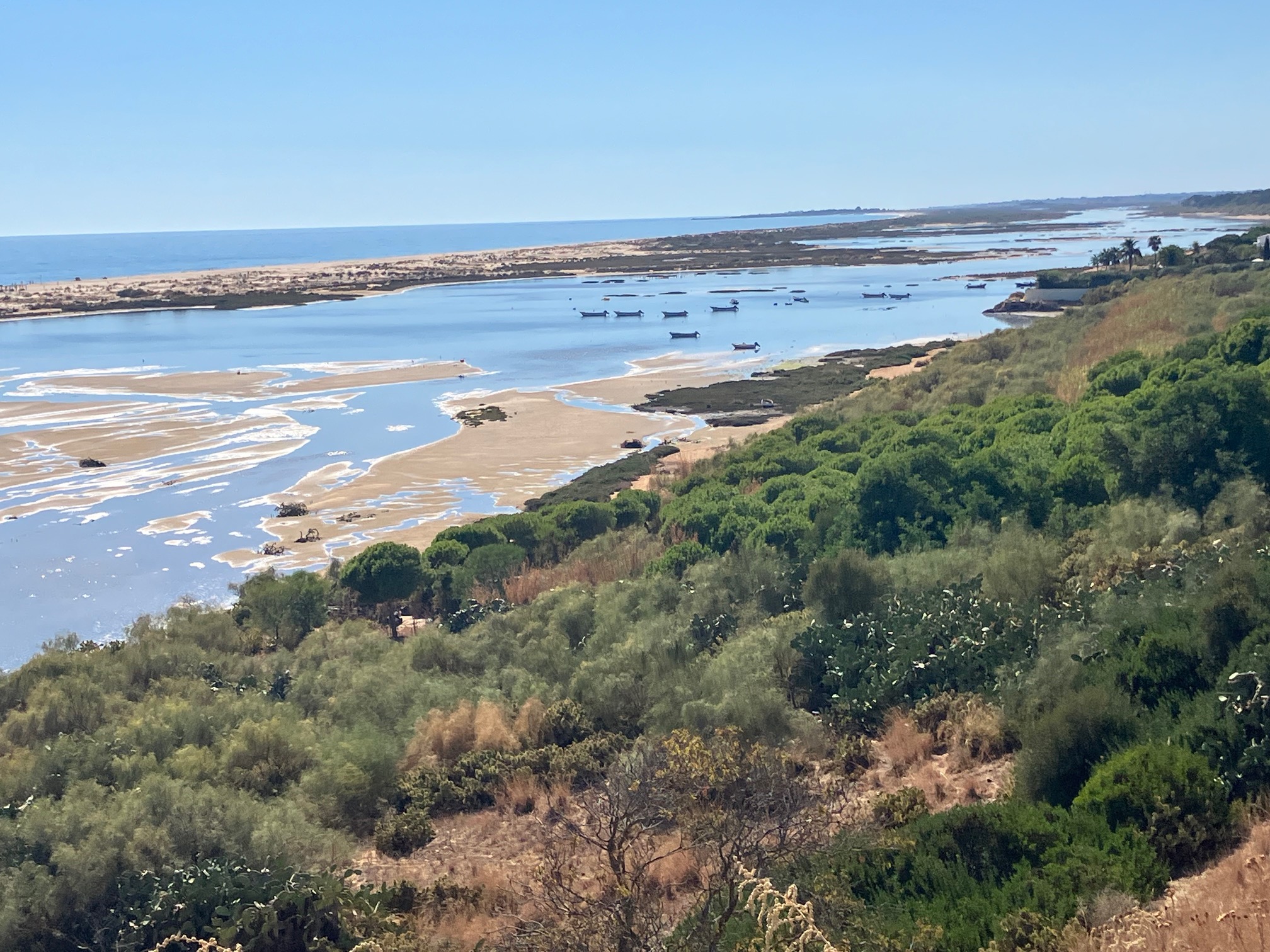
The Algarve, with its stunning beaches and rolling hills and olive tree orchards, is one of the more famous region’s of Portugal and it didn’t disappoint. We rode through some varying landscapes with views of the Atlantic Ocean and eventually stopped and took a tour of a salt making operation, with at least five or 10 ponds used to settle and separate the salt fragments over time. One of our leaders – Dave Reynolds-Gooch of Bainbridge Island – was instructed to walk on a salt pond, where we all threw salt in the air in celebration.
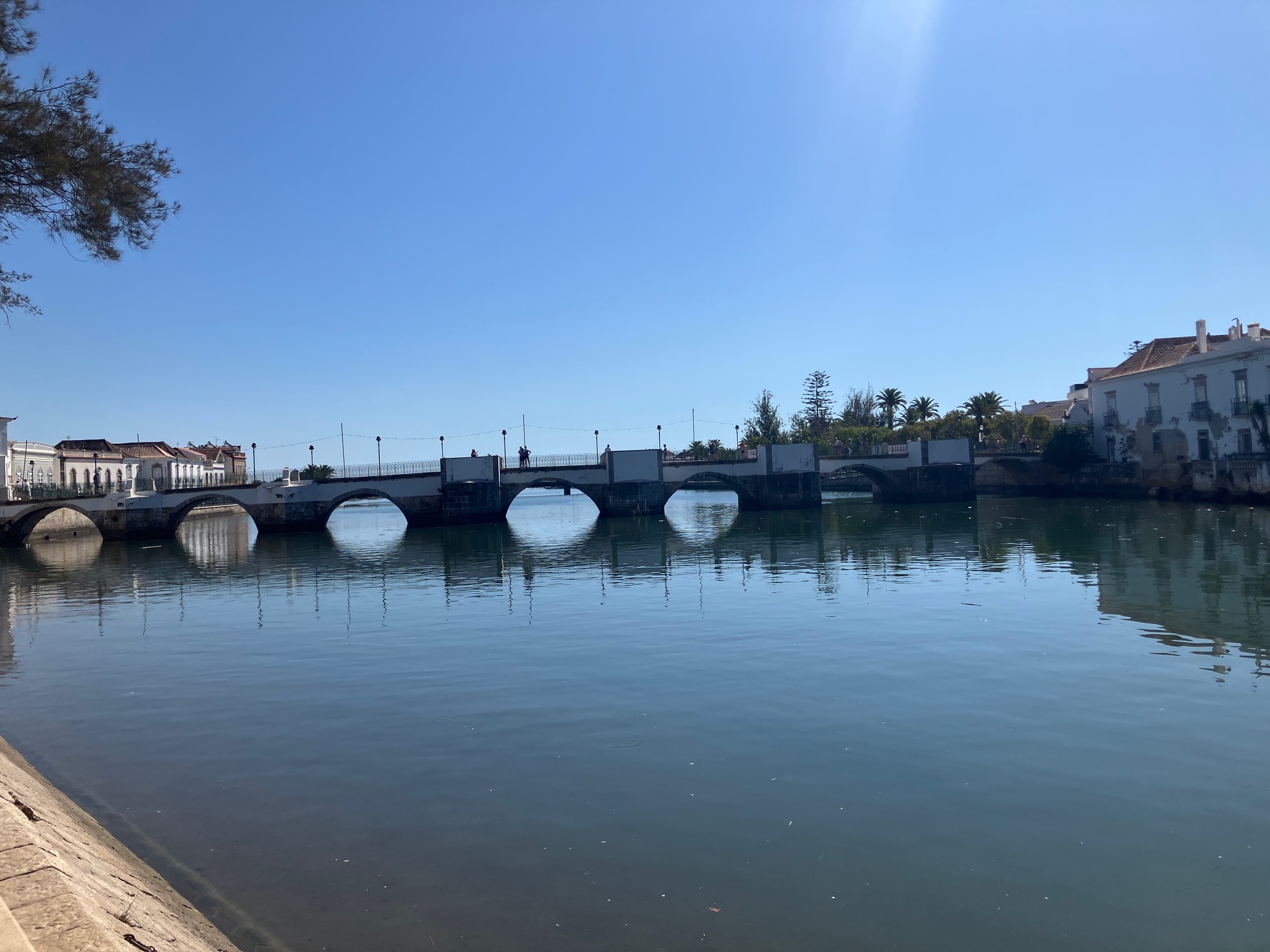
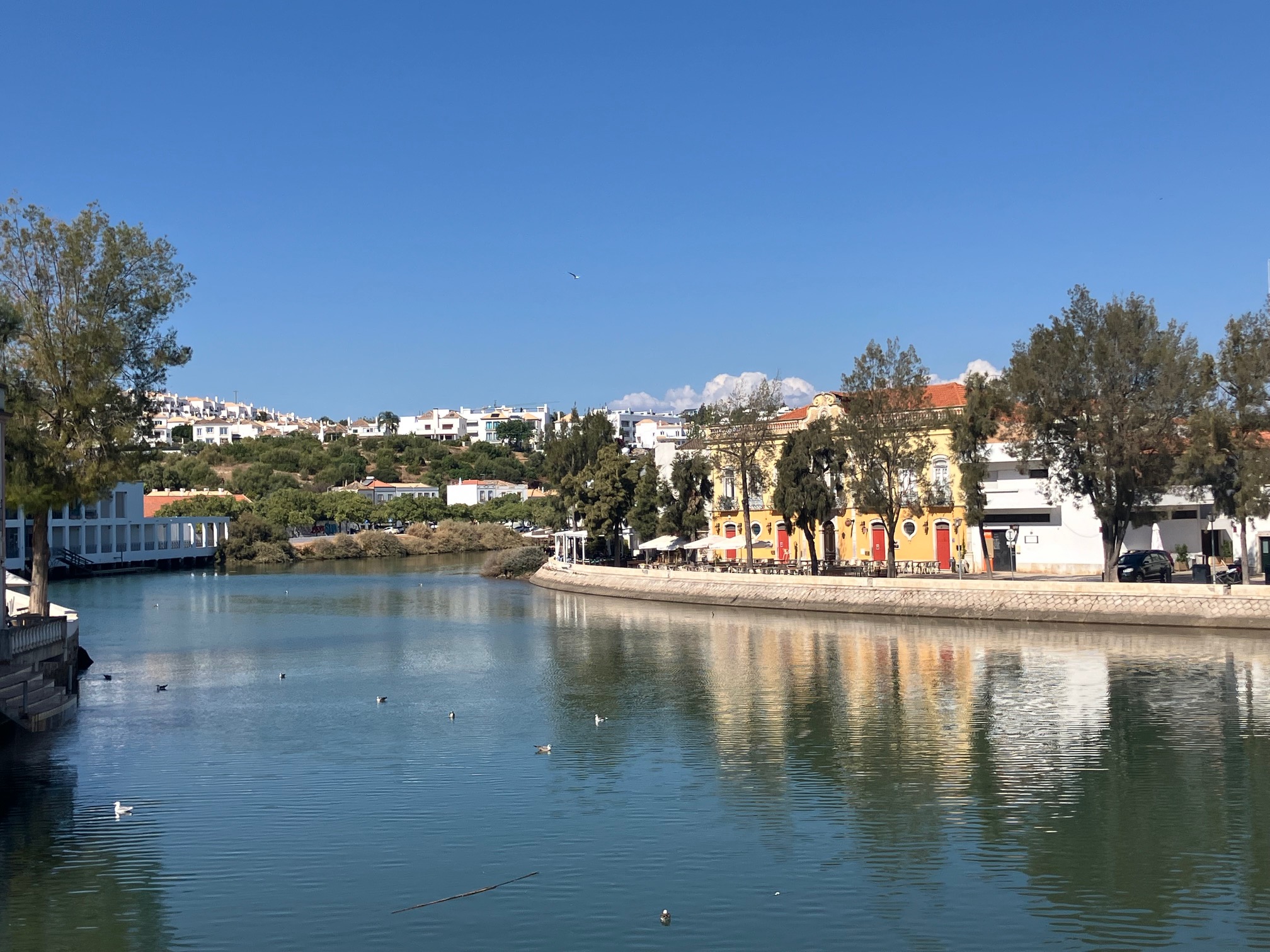
Our boutique hotel for the next two nights was very comfortable and within walking distance of the beach and some nice restaurants. We sat on the veranda of one eatery that had an incredible view of the sunset, the beachfront and the shimmering Atlantic Ocean. It was a scene we won’t soon forget. … We heard or read that Portugal is a destination for American and European Ex-pats. If we were to go that route, the City of Tavira would certainly be one place to consider. We rode through a number of charming small villages in and around olive and pomegranate orchards and up and down hills until we arrived at this picturesque seaside destination.

The Formosa River runs through the town and adds to its beauty with several old but beautifully constructed bridges that lead from one part of the Tavira to the other. There’s an interesting plaza, where one can grab lunch in any number of laid back restaurants or shop for local pottery or other gifts. The small city, of course, goes back to Roman times and its whitewashed buildings, castle and mosque are descendants of the Moorish occupation between the 8th and 13th centuries. We made our way back through some other lovely seaside villages and rolling hills, where again olive, lime, and pomegranate trees were plentiful.
We left the Algarve the next day and headed by bus to Cascais, a larger but equally beautiful seaside town not far from Lisbon. We spent our last day and evening taking in the sites and sounds of Portugal in this city before heading out the next day for our the return trip to Seattle. It was a memorable time spent with some incredible guides, with old friends and new ones, and visiting a country that has much to offer for foodies, history buffs, bicyclists and walkers alike.
Obrigado!
Source Materials: Vermont Bike Tours www.vbt.com, Wikipedia https://en.wikipedia.org/wiki/History_of_Portugal, Britannica https://www.britannica.com/place/Portugal/History
If you’d like to read more articles from The Island Wanderer Blog website, click here, to subscribe to The Island Wanderer Blog, click here.
ADVERTISE WITH US! We offer exceptional rates and packages for advertisers, to learn more, contact us at Contact Us | THE ISLAND WANDERER


